
Find Some Good Reads with My Textbook Explorer & Reading List

A few weeks ago I finally made a personal website, and I’ve been gradually putting things up there. It started as something I made mostly for myself (kind of like how I’m the primary user for most of my favorite LibGuides I’ve created). But there are now two resources that I think will be useful to readers of this blog, whether you’re teaching an AI or legal tech course, helping faculty who are, or just looking for something to read or circulate to colleagues.

The AI in legal practice textbook explorer

Books and teaching resources on AI in legal practice collects 47 textbooks, casebooks, study aids, practitioner books, and open materials. For most of them, I’ve added the table of contents with each chapter tagged by topic. That means you can pick a topic, like prompting or hallucinations, and get the specific chapters that cover it, not just a list of titles.
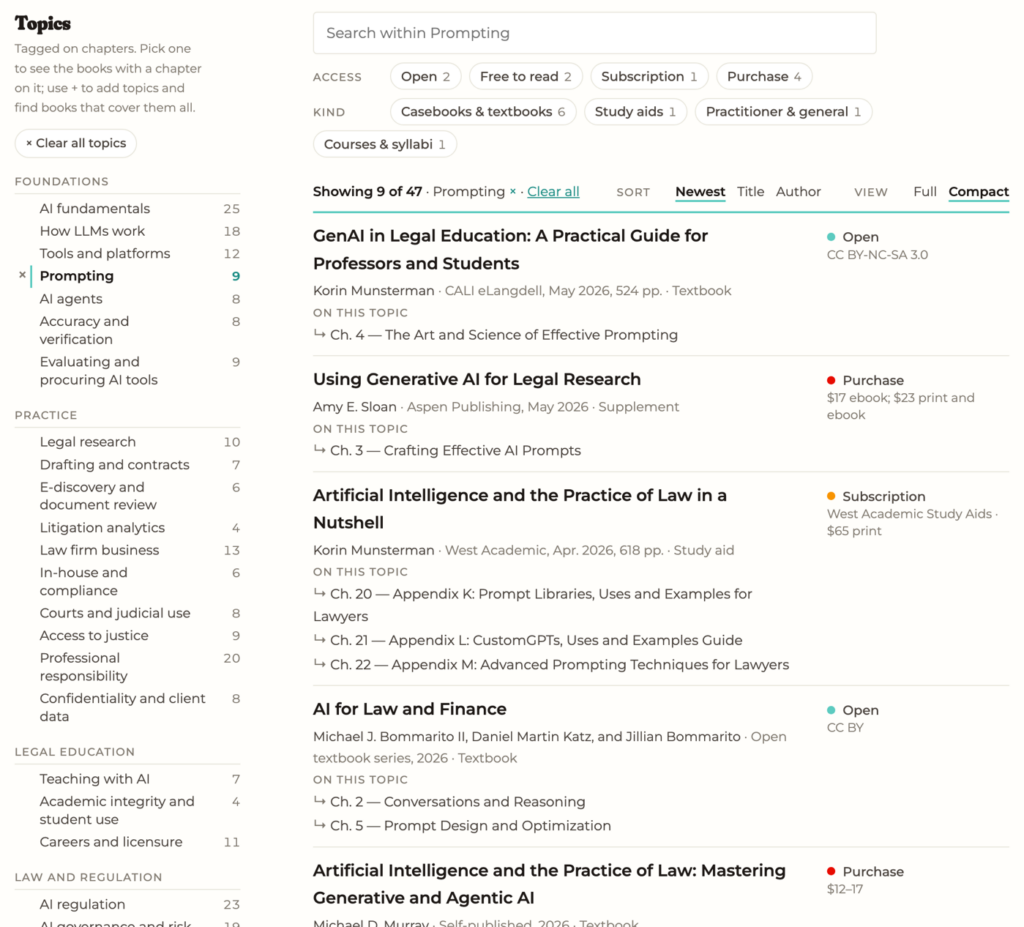
The book explorer with the Prompting topic selected, showing nine books and the specific chapters in each that cover prompting.

You can also filter by how you’d get the book. If I’m just assigning a chapter, I usually want only the open, free, and typically licensed titles (several are in the West Academic Study Aids package many academic law libraries already subscribe to). Or you can go the other way and look for one book to purchase that covers everything you want. You can combine topics, search chapter titles, and share a link to exactly the filtered view you’re looking at.
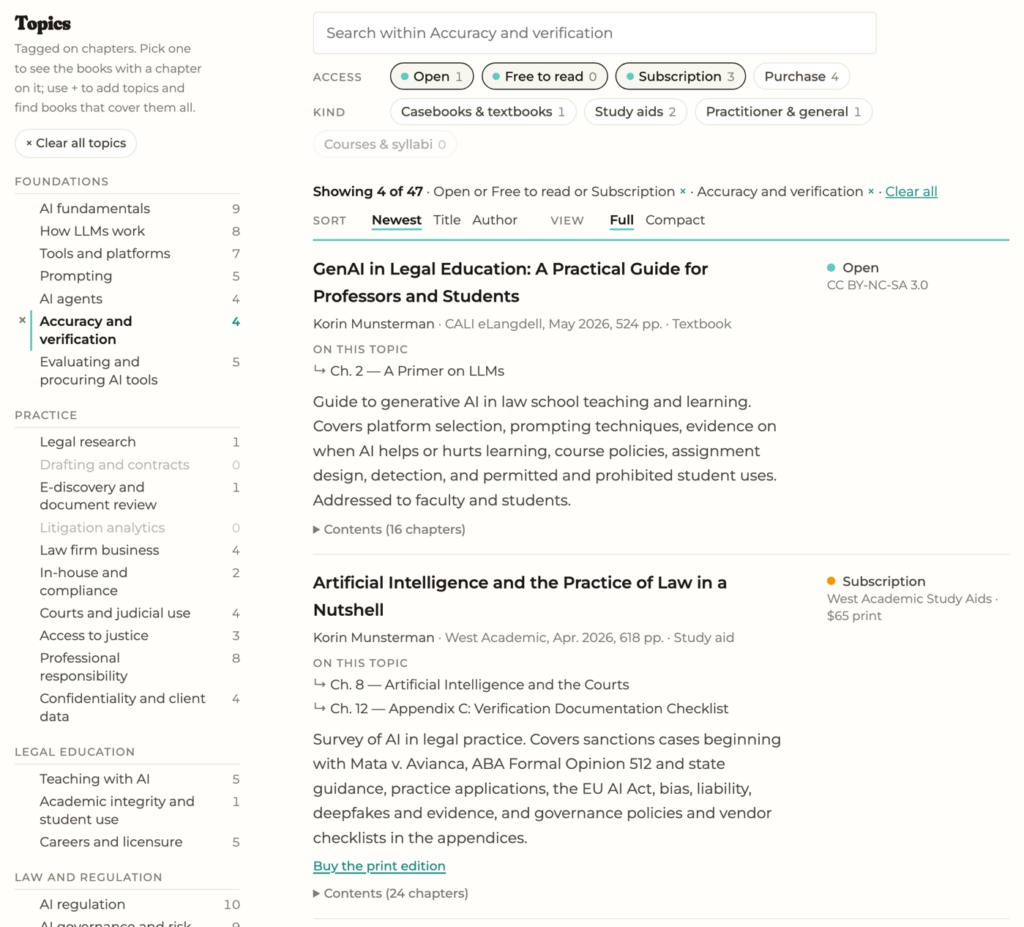
The book explorer filtered to open, free, and subscription titles with chapters on accuracy and verification.

My 21st Century Lawyering reading list

I’ve also posted the full reading list from my AI/legal tech class this spring, class by class. It covers 26 classes and 100+ readings, from LLM basics to vibe-coding to access to justice, with required and optional readings marked and the time estimates I gave students. These are fast-moving topics, so some of it may need updating, but most of it should still be relevant in a year (I hope!).
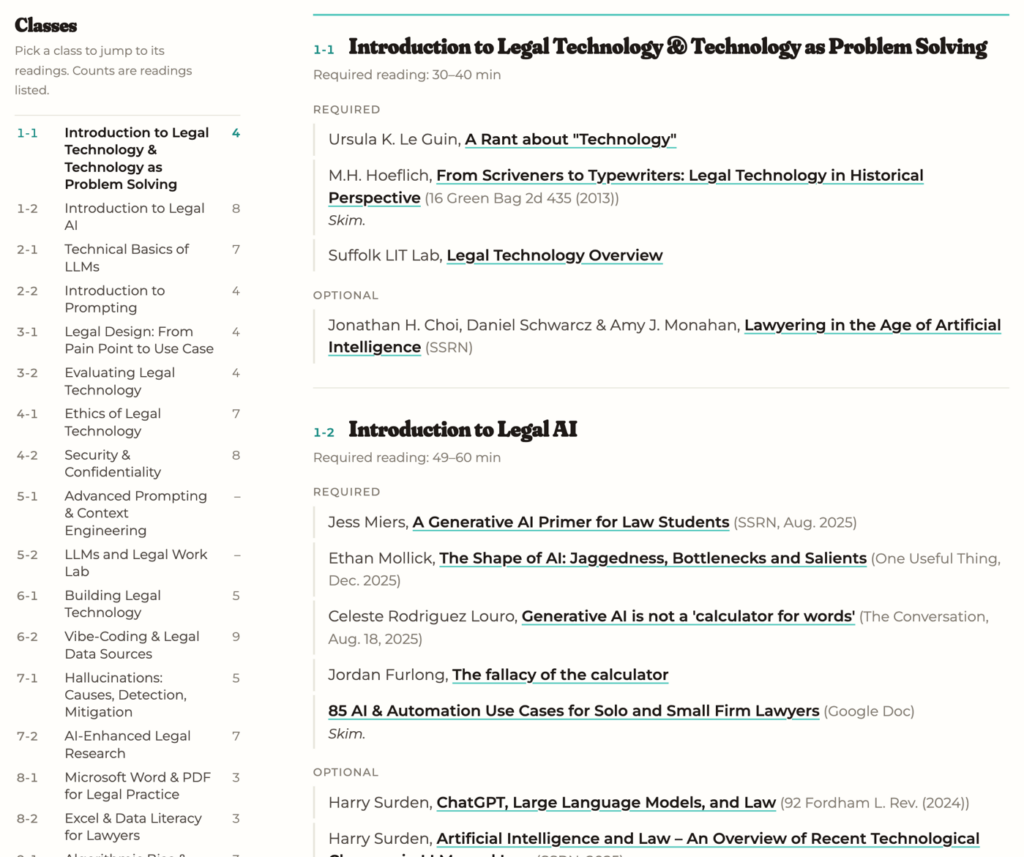
The 21st Century Lawyering reading list, with a list of classes on the left and each class's required and optional readings on the right.

Feel free to borrow anything. And if you know of a book I’ve missed, or a reading that worked well in your class, please let me know. I plan on keeping the book list updated, and posting new class reading lists in future years.

New Resources for Teaching with Legal AI and Keeping Up with the Latest Research

Today’s guest post comes from the University of Denver Sturm College of Law’s John Bliss. Professor Bliss has been kind enough to share some resources that he has crafted to help teach AI to lawyers and law students. In addition, he has launched a new blog which would likely be of interest to our audience so we are happy to host this cross-over event.

Teaching

I recently posted to SSRN a forthcoming article on Teaching Law in the Age of Generative AI, which draws from early experiments with AI-integrated law teaching, surveys of law students and faculty, and the vast new literature on teaching with generative AI across educational contexts. I outline a set of considerations to weigh when deciding how to incorporate this tech in the legal curriculum. And I suggest classroom exercises, assignments, and policies. See https://papers.ssrn.com/sol3/papers.cfm?abstract_id=4682456.

Blog

I’m also organizing a blog that provides up-to-date analysis of research on AI’s legal capabilities. You can subscribe at http://ai-lawyering.blog. Let me know if you’re interested in contributing. The motivation for the blog is that legal AI is a fast-moving field. It is all too common that our discussions are based on outdated and inaccurate information. Empirical findings are often misconstrued in mass and social media. The blog aims to address this issue by reviewing the latest high-quality research, emphasizing empirical studies of AI capabilities as well as scholarship on the implications of this technology for lawyers and other stakeholders in the legal system.

New Program on Generative AI for Legal Practitioners

I’m working with a non-profit teaching lawyers and other members of the legal profession about generative AI: http://oak-academy.org. Just last week, we held our first session with a group of lawyers, law students, and academics. It seemed to go well!

I look forward to continuing conversations on these topics. Please feel free to reach out—jbliss@law.du.edu